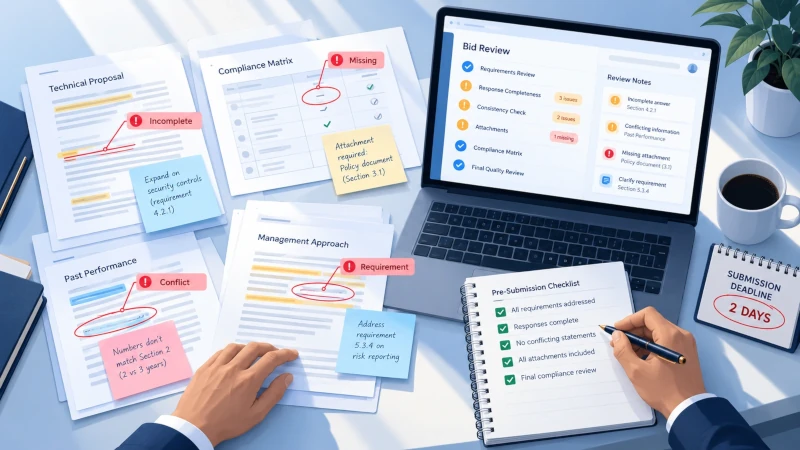
Proposal review
Bid Review: How to Find Missing Requirements Before Submission
Learn how to identify missing RFP requirements, incomplete answers, conflicting statements, and overlooked attachments before submitting a bid. Explore practical review methods and automated compliance analysis.
Bid Review: How to Find Missing Requirements Before Submission
The submission deadline is approaching, and the proposal team has completed what appears to be a comprehensive response. The technical solution has been described, pricing has been reviewed, supporting documents have been assembled, and several people have already examined their respective sections. Yet during the final review, someone discovers that a mandatory requirement has never been addressed.
The problem may be relatively simple, such as a missing attachment or an incomplete response to a technical question. It may also be more serious, involving conflicting contractual commitments, an unsupported claim, or an eligibility requirement that the bidder cannot satisfy. Discovering these issues shortly before submission leaves little time to investigate their implications and prepare appropriate corrections.
Bid review is the process of examining a completed or nearly completed proposal against the original procurement requirements to identify omissions, inconsistencies, and compliance risks before submission. It provides an independent assessment of what the proposal actually contains, rather than relying entirely on what its authors intended to include.
A structured review can identify problems while they are still correctable. Understanding why these problems occur, and how to find them systematically, is essential for organizations that regularly respond to complex RFPs.
Why Missing Requirements Are Difficult to Detect
Large Requests for Proposal (RFPs) rarely present their requirements in one convenient location. Technical specifications may appear in the main document, qualification conditions in an appendix, pricing instructions in a separate template, and contractual obligations in another attachment. Clarifications and amendments can introduce additional requirements after proposal preparation has already begun.
The response may be equally fragmented. Technical specialists prepare solution descriptions, commercial teams develop pricing, legal representatives examine contract provisions, and project managers document implementation schedules. Each contributor understands their assigned material, but no single person necessarily maintains a complete view of the relationship between every requirement and every response. This division of responsibilities is reasonable and often necessary. Complex proposals require specialist knowledge, and individual sections benefit from detailed technical or commercial review. Problems arise when the organization assumes that reviewing each section independently is equivalent to reviewing the proposal as a complete submission.
A requirement may fall between responsibilities because its wording involves multiple disciplines. For example, a requirement concerning data retention could involve application functionality, infrastructure operations, information security, and contractual obligations. Each specialist may assume another team member has addressed it.
Under deadline pressure, the problem becomes more pronounced. Reviewers concentrate on substantial sections, visible formatting problems, and issues already identified during preparation. Smaller requirements embedded in lengthy paragraphs or tables may receive less attention.
The central challenge is maintaining traceability between every requirement and the specific evidence demonstrating that it has been addressed.
How Manual Bid Reviews Usually Work
Traditional bid reviews typically involve reading the RFP alongside the proposed response, searching for relevant sections, and recording findings in a spreadsheet or review document.
A proposal manager may begin with the technical requirements, checking whether each requested capability appears somewhere in the response. Technical reviewers examine the architecture and implementation details, while commercial and legal reviewers verify pricing schedules, declarations, and contractual commitments. When an omission is discovered, the reviewer records a comment or requests a correction from the responsible author. Revised sections are incorporated into the proposal, and the document proceeds through another review cycle.
This process can work effectively for smaller bids, especially when the requirements are clearly organized and the response follows the same structure. Experienced reviewers often recognize common procurement obligations and can identify technical weaknesses that a purely mechanical comparison would miss.
However, manual review becomes increasingly demanding as document volume grows. A reviewer may need to search hundreds of pages across several files, interpret requirements expressed in different terminology, and determine whether a particular statement provides sufficient evidence. Document revisions add another complication. A corrected technical section may introduce a contradiction elsewhere, while replacing an attachment may invalidate an earlier compliance assessment. Maintaining a reliable understanding of the complete submission requires repeated cross-referencing.
The difficulty is therefore partly organizational and partly informational. Reviewers need a consistent method for identifying requirements, locating evidence, recording findings, and confirming that corrections have actually resolved the original problems.
The Four Most Common Problems Found During Bid Review
Although every procurement has its own characteristics, several types of deficiencies appear repeatedly in proposal preparation.
1. Requirements That Have Been Overlooked
An overlooked requirement is one that receives no identifiable response. It may be hidden within a paragraph containing several obligations, included in an appendix, or introduced through an amendment.
Consider a technical specification requiring encrypted document storage, role-based access control, audit logging, and configurable retention periods. The proposal may provide detailed explanations of encryption and access control while never mentioning retention configuration.
Because the surrounding section appears complete, the missing capability can be difficult to notice without checking each obligation separately.
Requirements containing multiple distinct conditions should be divided into individually verifiable items. This prevents a response covering one part of a requirement from being mistaken for complete compliance.
2. Answers That Are Present but Incomplete
An incomplete response addresses the general subject of a requirement without demonstrating that the specific obligation has been satisfied.
For example, an RFP may require multifactor authentication for administrative users. A proposal stating that the system provides secure authentication does not establish support for the requested mechanism.
Similarly, a requirement to provide disaster recovery procedures may not be satisfied by a general statement that the system is highly available. Disaster recovery and availability are related concepts, but they address different operational circumstances.
These findings require reviewers to evaluate the meaning of the response rather than merely locate matching terminology.
3. Inconsistent Statements Across Documents
Different sections of a proposal may contain conflicting commitments, particularly when multiple authors work independently.
The executive summary might promise implementation within three months, while the project schedule allocates sixteen weeks. A technical section may describe customer-managed infrastructure, while the pricing schedule assumes a vendor-hosted service. Such inconsistencies create uncertainty about the bidder's actual proposal, and they may affect technical evaluation, commercial interpretation, or subsequent contractual negotiations.
Cross-document consistency therefore deserves explicit attention during review, particularly for delivery schedules, scope boundaries, pricing assumptions, service levels, and responsibilities.
4. Missing or Invalid Supporting Documents
A technically complete proposal may still be missing mandatory supporting evidence.
Common examples include unsigned declarations, omitted customer references, incomplete pricing templates, expired certifications, and attachments referenced in the proposal but absent from the final package.
These problems are often administrative rather than technical, yet their consequences can be substantial. Depending on the procurement rules, certain omissions may affect eligibility or prevent the submission from being evaluated.
Reviewers must verify that supporting documents are present, valid, and consistent with the requirements, rather than accepting references to those documents as sufficient evidence.
A Practical Example of Finding Compliance Gaps
Consider a fictional company, Northbridge Technology Solutions, preparing a proposal for an enterprise document management system.
The RFP package contains a 90-page main document, technical specifications, a security questionnaire, commercial conditions, and several required response schedules. Northbridge has prepared a 125-page proposal with supporting attachments.
The submission deadline is two business days away. The technical team believes its work is complete, the commercial team has approved pricing, and the proposal manager is preparing the final package.
During a structured review, the team identifies the following findings.
| Requirement | Review Finding | Required Action |
|---|---|---|
| Role-based access control | Fully addressed | No correction |
| Microsoft Entra ID integration | General identity integration described | Clarify the specific integration |
| Disaster recovery procedures | Required procedures missing | Provide supporting documentation |
| Implementation timeline | Conflicting delivery commitments | Reconcile schedule and narrative |
| Client references | One required reference omitted | Complete the reference schedule |
| Commercial declaration | Document present but unsigned | Obtain authorized signature |
These findings represent different kinds of problems. The identity integration response needs clarification, the disaster recovery requirement lacks evidence, and the implementation timeline contains conflicting information. The commercial declaration requires a straightforward administrative correction.
The proposal manager assigns each finding to the appropriate owner and establishes a correction deadline. Technical specialists update the solution description, operations personnel provide recovery documentation, and the project manager reconciles the implementation schedule.
After the corrections, the team performs another review to verify that the revised proposal addresses the original requirements.
This hypothetical example illustrates why an overall assessment of proposal quality is insufficient. A well-written response can contain several unrelated compliance problems, each requiring a different corrective action.
Building a Structured Review Process
A reliable bid review begins with a complete requirements register. This register should include every applicable requirement from the original RFP, supporting documents, and amendments.
Each requirement should retain its source reference and receive a unique identifier. This makes it possible to locate the original instruction and determine whether subsequent revisions have changed its meaning.
The next step is to connect each requirement to the relevant response. Reviewers should identify the document, section, and supporting evidence that demonstrates compliance.
A practical compliance assessment can use three primary categories: Met, Partially Met, and Not Met. Where necessary, reviewers should separately record whether a finding represents missing evidence, an actual capability gap, or a potential interpretation issue.
The review should also distinguish between mandatory and optional requirements. A minor weakness in an optional feature may affect scoring, while an unresolved mandatory eligibility condition may create a much greater submission risk. Once findings are documented, each issue needs an owner, a required corrective action, and a deadline. Corrections should then be verified against the original requirement rather than accepted solely because an author reports that the issue has been resolved.
This approach creates an auditable connection between the procurement instructions, the submitted response, and the review decisions.
How Automated Analysis Supports Bid Review
The most repetitive part of a manual review is often the process of locating requirements and finding corresponding evidence across multiple documents.
Automated document analysis can reduce this work by extracting requirements from the RFP and comparing them with the proposed submission. Instead of beginning with an unstructured collection of documents, reviewers receive an organized assessment highlighting areas that require attention.
BidCompliance is designed to support this pre-submission review process. Teams can upload their RFP documents and proposed bid response for analysis, allowing the application to identify requirements and evaluate how they are addressed.
The resulting compliance matrix identifies requirements as Met, Partially Met, or Not Met, with references to relevant document sections that reviewers can inspect.
For the fictional Northbridge proposal, automated analysis could help identify the missing disaster recovery response, highlight the incomplete identity integration explanation, and direct reviewers toward sections requiring closer examination.
These findings would provide a starting point for the review team. The technical architect would still need to confirm whether the proposed identity integration satisfies the requirement, while the proposal manager would verify that supporting documents are included in the final submission.
Automated analysis is particularly useful when requirements are distributed across multiple files or expressed using terminology that differs from the proposal.
However, automated findings must be validated. Relevant text does not always establish compliance, and an automated system may misinterpret a requirement or fail to recognize supporting evidence.
The strongest approach combines automated document comparison with experienced reviewers who understand the technical, commercial, and contractual implications of the findings.
Why Review Timing Matters
Many organizations leave their most comprehensive compliance review until the proposal is nearly ready for submission, sometimes because the team is still making changes to the technical solution or waiting for commercial approvals. By that point, however, reviewers have little room to maneuver. A missing signature can usually be resolved quickly, provided the authorized person is available, but an incomplete technical response may require several specialists to revisit the proposed solution, reconcile assumptions, and rewrite sections of the document. Discovering that problem on the afternoon before submission puts unnecessary pressure on everyone involved.
A better approach is to review compliance at several points during proposal preparation, beginning when the requirements are first assigned to individual contributors. At this stage, the proposal manager should be able to establish who is responsible for each requirement and where the response will appear. This initial review rarely involves evaluating completed answers, since much of the proposal may not yet exist. Its purpose is to ensure that requirements have not been overlooked or left without an owner.
The next review becomes useful once the technical and commercial sections are substantially complete. Reviewers can examine the actual responses, identify unsupported claims, and determine whether the proposal addresses what the buyer requested. There is still an opportunity to bring the relevant specialists together, resolve conflicting interpretations, and obtain additional evidence without disrupting the entire submission schedule.
Shortly before submission, attention should shift toward verifying that previously identified problems have been resolved and that the approved documents have been assembled correctly. This review should include the complete package, not merely the main proposal document, because missing attachments and outdated supporting materials frequently originate during final document preparation.
The advantage of reviewing at different stages extends beyond having more time to make corrections. It also helps the team recognize the difference between a response that needs clarification and a proposed solution that requires substantial changes. The first may be resolved through better documentation, while the second could affect pricing, delivery commitments, or the feasibility of the entire proposal. Discovering these distinctions early allows the organization to make considered decisions rather than hurried compromises.
Avoiding False Confidence in Compliance Scores
A compliance matrix provides useful visibility into the overall state of a proposal, particularly when hundreds of individual requirements must be addressed. However, the summary statistics can create a misleading impression of completeness. A proposal containing 200 requirements, with 190 assessed as fully met, produces a compliance rate of 95%. That may look encouraging in a management report after several weeks of preparation, especially when the remaining findings appear relatively small in number. But the percentage says very little about the actual consequences of those outstanding requirements.
Consider what those ten unresolved items might contain. Perhaps eight concern optional technical features that would influence evaluation scores without affecting eligibility. The remaining two, however, could involve a mandatory professional certification and an essential security requirement. Depending on the procurement rules, either could create a serious obstacle to acceptance, regardless of how thoroughly the other 190 requirements have been addressed.
The significance of an unresolved requirement matters considerably more than its contribution to an overall percentage.
There is another complication. A requirement classified as Not Met does not necessarily indicate that the bidder lacks the requested capability. Sometimes the solution satisfies the requirement, but the proposal fails to explain how, or the relevant evidence has been omitted from the submission package. An application may support multifactor authentication, for example, while its technical documentation discusses authentication only in general terms. The reviewer has correctly identified a documentation gap, but the corrective action involves providing evidence of an existing capability rather than developing new functionality.
Other findings reveal genuine limitations that cannot be resolved through better wording. A proposed system might lack a required integration, the delivery schedule may be incompatible with the buyer's deadline, or the organization may not hold a mandatory qualification. These situations require technical or commercial decisions, potentially involving changes to the proposed solution or a reconsideration of whether to submit the bid.
A useful compliance report must distinguish between these circumstances and make unresolved mandatory requirements immediately visible. Overall percentages can help management track progress between review cycles, but they should never become the basis for declaring a proposal ready. That decision requires understanding what remains unresolved, whether the gaps are correctable, and what consequences they may have under the specific procurement rules.
Final Review Before Submitting the Bid
By the time a proposal reaches its final review, the substantial technical and commercial questions should already have been resolved. The focus now shifts to the submission package itself, including the documents that have been revised, converted, combined, signed, and prepared for delivery. This stage may appear administrative compared with evaluating a complex technical solution, yet seemingly minor mistakes can undermine work that took weeks to complete.
Consider a familiar situation. The technical team has approved the latest solution description, the commercial director has signed off on pricing, and the proposal manager has assembled the final files. During document preparation, however, an earlier version of the implementation schedule is included by mistake. The main proposal now promises delivery within twelve weeks, while the attached schedule still shows sixteen. Nobody notices because both documents were reviewed individually, and the team assumes that the final package contains the approved versions.
Problems of this kind are difficult to prevent through ordinary proofreading. They originate in document coordination, version management, and the practical process of assembling a submission from material prepared by several contributors. A reviewer examining only the main proposal may never see the inconsistency, while someone checking that all required attachments are present may have no reason to question whether those attachments contain the latest approved information.
The final verification should therefore examine the exact files intended for submission. That includes confirming that previously requested corrections are present, required declarations have been signed, pricing schedules contain approved figures, and supporting documents correspond with the claims made elsewhere in the proposal. References between documents deserve particular attention because a revision to one attachment can invalidate a statement that was previously correct.
Electronic procurement portals introduce additional considerations. Some impose document size limits or accept only particular file formats, while others require users to complete several steps before a submission is formally recorded. Uploading all the files does not necessarily mean the bid has been submitted successfully. The proposal team should understand the procedure in advance, including any confirmation or acknowledgment that establishes successful receipt.
After submission, the organization should retain the approved document package and the corresponding compliance review records. These materials can be useful during procurement clarifications, contractual discussions, or internal reviews of the bidding process. They also provide evidence of which issues were identified, how they were resolved, and what was ultimately submitted.
Making Bid Review a Repeatable Business Process
Organizations that respond to RFPs regularly often develop their own habits for reviewing proposals. Experienced proposal managers remember recurring requirements, technical specialists recognize familiar evaluation criteria, and commercial teams maintain templates for pricing and declarations. These practices can be effective, particularly when the same people work together over several submissions and understand how responsibilities are divided.
Difficulties emerge when too much of the process depends on individual experience. A new proposal manager may not know that a particular appendix usually contains mandatory declarations. A technical reviewer may assume that contractual requirements are being handled elsewhere, while the commercial team expects the technical authors to address service-level commitments. The process appears to function because everyone is completing their assigned work, even though certain obligations may have no clear owner.
Making bid review repeatable begins with a relatively simple objective: every requirement should have an identifiable source, an assigned responsibility, a corresponding response, and a recorded review outcome. The organization also needs an agreed method for handling findings that cross departmental boundaries. A contractual provision concerning disaster recovery, for example, might require input from legal, infrastructure operations, and solution architecture. Without defined ownership, each group can complete its own review while the combined requirement remains unresolved.
For smaller procurements, a well-maintained spreadsheet and a disciplined review meeting may provide everything necessary. Larger or more complex submissions introduce different demands. Hundreds of requirements may be distributed across documents prepared by multiple organizations, with amendments arriving while responses are already being written. Maintaining accurate cross-references becomes difficult, especially when revisions affect previously reviewed sections. Structured document management and automated compliance analysis can help reduce that repetitive work, provided the findings are still examined by people who understand the proposed solution and its contractual implications.
The most useful improvements often become apparent when an organization examines how its last few bids were actually prepared. Were the same types of requirements repeatedly missed? Did reviewers spend excessive time searching for evidence that already existed? Were important decisions postponed because nobody had clear responsibility for resolving them? Perhaps corrections made during the final review introduced additional inconsistencies, creating another cycle of document changes just before submission.
Answers to these questions reveal where changes are needed. Some organizations will benefit from assigning requirements earlier or collecting supporting evidence before drafting begins. Others may need clearer coordination between technical and commercial teams, more disciplined version control, or automated tools that make omissions easier to identify. The appropriate solution depends on the complexity of the bidding process and the problems that repeatedly consume time.
A successful bid review provides confidence that the proposal has been examined against the buyer's actual requirements, with outstanding issues understood and addressed before submission. Achieving that consistently depends on the quality of the process behind the review, including how requirements are managed, how evidence is verified, and how the organization responds when problems are discovered.
Ready to review your next bid with more confidence?
Upload your RFP and bid documents to identify compliance gaps with cited evidence.
Start a compliance check