Proposal review
How BidCompliance Can Identify Compliance Gaps in Bid Responses
Discover how BidCompliance uses AI-powered document analysis, semantic matching, and evidence extraction to identify missing requirements, incomplete responses, and unsupported compliance claims before bid submission.
How BidCompliance Can Identify Compliance Gaps in Bid Responses
The technical director of a software company has just approved a proposal for a substantial government contract. The solution architecture is sound, the implementation plan is realistic, and the commercial team has confirmed the pricing. Everyone involved believes the proposal addresses the procurement requirements.
Then, three days before submission, the proposal manager discovers a requirement for documenting how the system will recover from a regional infrastructure failure. The technical proposal discusses backups, redundant services, and disaster recovery, but nowhere does it explain the recovery time commitment requested in the RFP.
The technical director knows the proposed architecture could potentially support that commitment. Unfortunately, what the company knows about its solution and what it has actually committed to in the proposal are two different things. This distinction causes problems in bid preparation. Procurement documents define obligations in one language, while proposal teams describe their solutions using another. Evidence is scattered across technical narratives, implementation schedules, appendices, and commercial documentation. Even a carefully prepared response can overlook conditions that appear relatively minor until somebody examines the original requirement.
BidCompliance is designed to investigate precisely these discrepancies. It compares the requirements contained in an RFP with the material submitted by the bidder, looking for missing answers, incomplete explanations, and evidence that may not adequately support a compliance claim. To understand what the application can identify, it helps to examine why this comparison is considerably more complicated than searching two documents for matching words.
The Difference Between Mentioning a Requirement and Satisfying It
Consider a procurement requirement stating that the proposed platform must support centralized identity management through Microsoft Entra ID. The bidder's technical proposal contains several pages describing authentication. It explains that the application supports OpenID Connect, SAML 2.0, external identity providers, and enterprise single sign-on. These technologies are relevant to the requirement. A technically knowledgeable reviewer would recognize the connection immediately. But has the requirement been satisfied?
The response establishes that the application supports authentication technologies commonly used for enterprise identity integration. It does not necessarily establish that integration with the customer's specific identity environment has been implemented, tested, or included in the proposed scope. A conventional document search may produce misleading results in either direction. Searching for "Microsoft Entra ID" could return nothing, suggesting that the requirement was ignored. Searching for "identity" or "authentication" could return dozens of passages, creating the impression that the requirement was thoroughly addressed. Neither result establishes compliance.
The meaningful question is whether the evidence in the proposal supports the particular obligation expressed in the RFP.
A similar distinction applies to service availability. An RFP may require 99.95% monthly availability, while the proposal describes redundant infrastructure and automated failover. Those architectural characteristics could help achieve the requested level of service, but they are not equivalent to an explicit contractual availability commitment. This is why requirements comparison must consider meaning, context, and the strength of supporting evidence. The challenge is not simply finding related content. It is determining how closely that content corresponds to what the buyer actually requested.
How BidCompliance Examines the Documents
The analysis begins with the documents themselves. A typical procurement package may include the main solicitation, technical specifications, security questionnaires, contractual schedules, and clarification documents issued during the tender period. The bidder's response is similarly fragmented, frequently containing a technical proposal, implementation plan, pricing schedules, declarations, and supporting attachments.
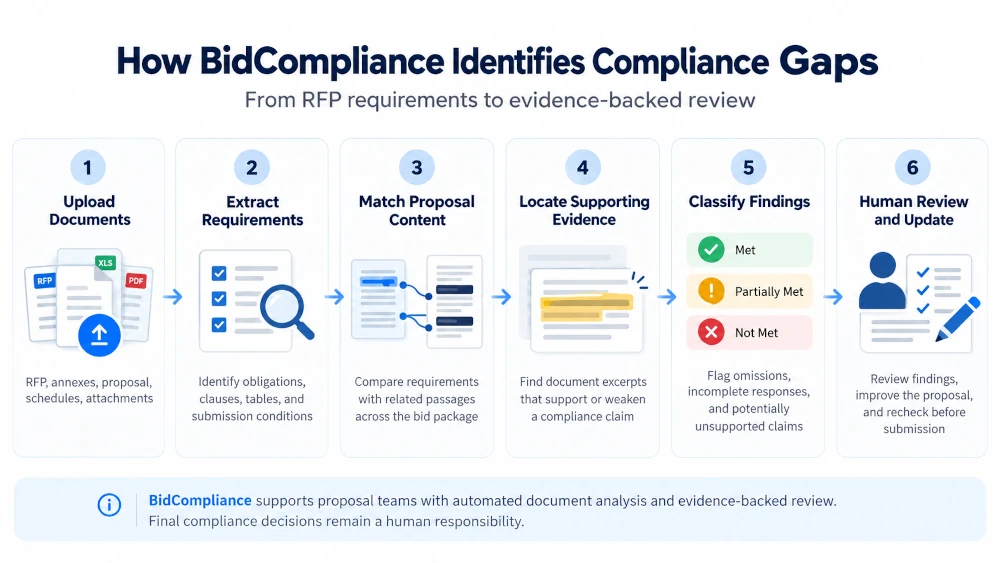
The BidCompliance document analysis system works with uploaded procurement and proposal documents, including supporting material, to establish the relationship between requirements and responses. Before meaningful comparison is possible, the content must be examined as individual obligations rather than treated as one continuous document.
A sentence such as "The solution shall provide encrypted storage, configurable retention, and complete audit logging" contains three requirements. The proposal could adequately explain encryption while offering no useful information about retention policies. Treating the original sentence as a single undivided obligation risks obscuring that difference. Requirements extraction therefore matters as much as the subsequent comparison. The objective is to identify what the buyer expects and preserve enough surrounding context to interpret each condition correctly.
Once the requirements have been identified, BidCompliance examines the submitted response material for evidence that corresponds to them. The analysis is not restricted to identical terminology. Relevant information may appear under a different heading, use technical language unfamiliar to the buyer, or be distributed across several parts of the proposal. The application then organizes its findings into a compliance assessment, classifying requirements as Met, Partially Met, or Not Met, with references to relevant supporting passages.
Those classifications are findings from a document review, not independent certification of the bidder's capabilities. Their usefulness depends on making the underlying evidence available for examination.
What Semantic Matching Makes Possible
Semantic matching refers to comparing the meaning of statements rather than depending exclusively on the words they contain. A buyer might require that authorized personnel be able to retrieve records for seven years after creation. The bidder could describe configurable document retention schedules, long-term storage policies, and permissions governing archived records. Although the wording differs considerably, the passages concern related functionality. Recognizing that relationship allows a document analysis system to identify evidence that a simple keyword search might overlook.
The difficult part begins after the relevant passage has been found. Does configurable retention mean the product can retain records for seven years? Is the capability included in the proposed configuration? Does the bidder commit to the required retention period, or merely describe a feature that could support it? These questions require evaluating the actual statements. A reference to an adaptable retention framework may be relevant without being sufficient.
For proposal reviewers, such findings are useful precisely because they expose the difference between a plausible technical connection and a documented commitment. Instead of searching the complete proposal to discover which section might apply, they can examine a specific passage and decide what additional explanation is necessary.
Semantic matching is particularly valuable when a bid has been prepared by multiple specialists. Procurement authors may describe requirements in operational terms, solution architects may focus on technical mechanisms, and commercial contributors may express commitments through schedules and contractual language. Their terminology will not always align, even when they are discussing the same obligation. BidCompliance brings these documents into a common requirement-level assessment, allowing the reviewer to investigate relationships that would otherwise require extensive cross-referencing.
Following a Bid Through an Actual Review Scenario
Consider a fictional technology company preparing a bid to provide a document management platform to a regional public agency. The procurement package contains approximately 110 pages of requirements and supporting schedules. The proposed submission includes a technical narrative, implementation plan, commercial proposal, security documentation, and several appendices. The company has completed its internal authoring review and believes the response is ready for approval.
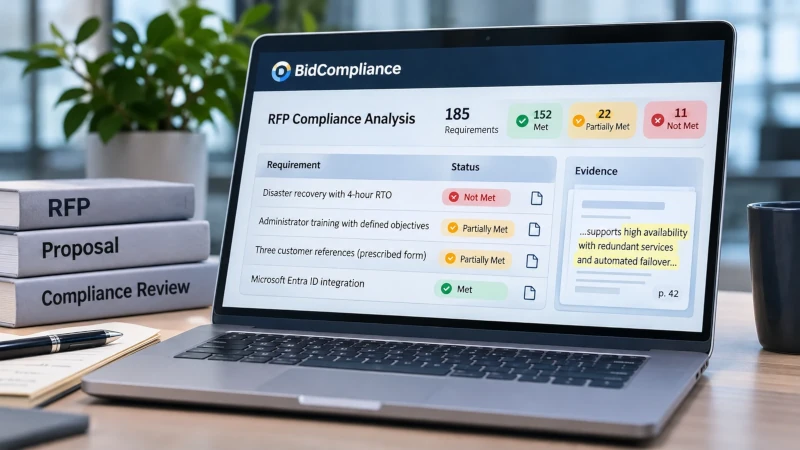
Rather than assuming the completed sections cover every obligation, the proposal manager uploads the procurement documents and the proposed bid package to BidCompliance. Suppose the analysis identifies 185 individual requirements. Most have corresponding evidence, but a smaller group receives Partially Met or Not Met assessments.
One finding concerns disaster recovery. The RFP explicitly requires a documented recovery procedure and a four-hour recovery time objective. The proposal includes a description of database replication, backup schedules, and infrastructure redundancy. It also states that the system is designed for high availability. The material is technically relevant, but it does not establish the recovery procedure or the requested recovery time commitment.
A reviewer examining the cited evidence can see why the issue requires attention. The proposal manager forwards the finding to the infrastructure architect, who confirms whether the proposed design can meet the objective and whether supporting operational procedures exist. If the design can satisfy the requirement, the team must document the commitment appropriately. If it cannot, the finding may reveal a genuine difference between the buyer's expectations and the proposed solution. Neither possibility should be settled merely by inserting the phrase "four-hour recovery" into the proposal.
Another finding involves administrator training. The implementation plan promises training sessions during deployment, but the RFP requires training materials, defined learning objectives, and a documented transition to the customer's operational team. The proposal is not silent about training. It simply fails to demonstrate that the full obligation has been addressed. The implementation lead can expand the training section and include the missing deliverables, assuming those activities form part of the proposed service.
The third finding is administrative rather than technical. The procurement requires three customer references using a prescribed form, but only two completed forms appear in the submitted package. No sophisticated interpretation is needed to recognize the deficiency once the corresponding requirement and evidence are examined. Yet omissions of this kind can be overlooked when reviewers concentrate primarily on the technical solution.
The proposal manager now has three distinct problems: a technical commitment requiring validation, an implementation response requiring additional detail, and an incomplete supporting attachment. They should not be handled as though they were the same issue.
From Identified Gap to Corrected Proposal
The team assigns each finding to an appropriate owner, with the requirement text and relevant document references attached to the corrective work. The infrastructure architect confirms the recovery capability and provides the necessary documentation. The implementation manager revises the training plan. The business development team obtains the remaining customer reference in the prescribed format.
After the corrections have been incorporated, the proposal manager prepares an updated document package and performs another BidCompliance analysis. This second review matters because correcting one finding does not guarantee that every related obligation has been addressed. A revised recovery commitment might need to be consistent with service-level provisions elsewhere in the proposal. Changes to the implementation plan may affect delivery dates or staffing assumptions in another document.
BidCompliance supports reviewing revised bid packages, allowing teams to examine the updated evidence rather than relying solely on reports that were prepared against earlier documents. In this fictional example, the application helps structure the investigation and subsequent verification. The technical, commercial, and contractual decisions remain with the people responsible for preparing the bid.
The Role of Evidence in a Compliance Assessment
A compliance classification without supporting evidence is difficult to evaluate. If a report declares that a requirement has been satisfied, the reviewer needs to know which passage supports that conclusion. Otherwise, the assessment simply replaces one unsupported statement with another.
BidCompliance provides references to relevant material in the proposal, allowing users to inspect the evidence behind individual findings. This is especially useful when the submission contains several documents and the supporting explanation does not appear in the section where a reviewer would normally expect it.
Consider an RFP requiring encryption of stored customer documents. A proposal might describe encryption in its security architecture while placing operational key management procedures in an appendix. Both passages could be relevant to understanding how the requirement is addressed. Their presence, however, does not necessarily demonstrate that the proposed configuration satisfies every condition in the RFP. The buyer may specify particular key ownership arrangements or require documentation that the bidder has not supplied.
Evidence extraction helps locate the material that should be reviewed. It does not make every statement within that material correct.
The distinction becomes even more significant when a proposal includes statements about certifications, third-party products, or future capabilities. A bidder might claim compliance with a security standard but omit the certificate required by the procurement. Alternatively, the certificate may exist but cover a different organizational scope. Document analysis can identify relevant statements and potentially insufficient supporting documentation. Establishing the certificate's validity, applicable scope, and acceptance under the procurement rules may require separate verification.
An automated finding should be understood in the context of the evidence available to the system. A missing document could indicate a proposal assembly problem rather than a deficiency in the underlying organization. Equally, a convincing technical description may contain commitments that cannot actually be delivered.
What BidCompliance Cannot Establish From Documents Alone
There are circumstances in which a proposal contains an apparently complete response, yet the actual feasibility of the commitment remains uncertain.
A requirement for processing a particular transaction volume illustrates the problem. The proposal might state that the system supports the requested throughput, supported by an architectural description. Evaluating whether that claim is achievable could require load testing, production measurements, capacity planning, or examination of external dependencies. Those facts cannot be established merely by finding the relevant sentence.
Contractual interpretation presents another limitation. Procurement requirements may refer to jurisdiction-specific provisions, standards, or contractual conditions whose meaning depends on documents and circumstances outside the submitted package. A compliance assessment can help identify related passages, but qualified professionals must determine whether the legal obligations have been satisfied.
BidCompliance is therefore best used as a pre-submission review and investigation tool, not as a guarantee that every requirement has been met. Its classifications provide a structured starting point for examining the proposal. Reviewers may confirm a finding, discover evidence that was not recognized, or decide that a requirement needs clarification from the buyer. In some cases, the correct outcome is to acknowledge a limitation rather than modify the response to appear compliant. That distinction protects the integrity of the proposal. A document should reflect what the bidder can actually deliver, not merely contain enough terminology to satisfy a superficial review.
Making Compliance Review Part of Proposal Preparation
Many organizations perform their most intensive compliance checks near the submission deadline, when the proposal is nearly complete and opportunities for substantial corrections are limited. Running a review earlier changes what the team can do with the findings.
Once a reasonably complete first draft exists, a BidCompliance analysis can expose requirements that have no identifiable response, technical explanations that need clarification, and supporting documents that have not been included. These findings can then be addressed while specialists are still actively working on their sections.
The proposal manager does not need to replace established authoring tools or approval procedures. The generated compliance assessment can inform the existing process, with issues assigned through the organization's normal coordination arrangements. For straightforward procurements, experienced reviewers and a carefully maintained spreadsheet may remain sufficient. Automated comparison becomes more attractive when documents are extensive, requirements are distributed across multiple files, or revisions create repeated cross-referencing work.
The volume of requirements is only part of the consideration. A relatively short RFP containing intricate contractual conditions or dependencies between technical capabilities may deserve more careful examination than a lengthy document composed largely of standardized declarations. What matters is whether the team can maintain a reliable connection between each requirement, the proposed response, and the evidence used to assess it.
A More Defensible Basis for Submission
A proposal is ready for submission when the organization has examined the relevant obligations, understands its commitments, and has resolved or consciously accepted the outstanding issues permitted by the procurement conditions.
An attractive compliance percentage is not enough. A handful of unresolved mandatory requirements may be far more consequential than numerous minor documentation findings. Nor should a Met classification prevent a technical reviewer from challenging a statement that appears unrealistic or unsupported.
BidCompliance helps by making the document comparison more systematic and the evidence easier to examine. Requirements that might otherwise remain buried in annexes can be brought into the review, while ambiguous responses receive attention before the submission package is finalized.
A practical starting point is to analyze a recently completed bid and investigate the findings that differ from the team's original assessment. Examine the supporting citations, determine whether the gaps are genuine, and identify which preparation practices allowed them to remain unresolved. Over time, those observations can improve how requirements are assigned, how evidence is collected, and when compliance reviews occur.
The purpose of BidCompliance is to help teams discover what their proposal may have missed and understand the evidence behind each finding. It gives the people responsible for making their own decisions, correcting deficiencies, and submitting a response that accurately represents the solution they intend to deliver.
Ready to review your next bid with more confidence?
Upload your RFP and bid documents to identify compliance gaps with cited evidence.
Start a compliance check