Proposal review
How to Check RFP Compliance Before Submission
Learn how to check RFP compliance before submission, identify missing mandatory requirements, verify supporting evidence, and reduce disqualification risks with a structured review process.
How to Check RFP Compliance Before Submission
A proposal team may spend several weeks preparing a response to a Request for Proposal (RFP). Technical specialists develop the proposed solution, commercial teams prepare pricing, legal representatives review contractual obligations, and proposal managers coordinate the submission. By the time the proposal is ready, considerable effort has already been invested.
Despite that preparation, a proposal can still contain omissions that compromise its eligibility or evaluation. A required certification may be missing, a technical requirement may receive only a partial response, or an attachment referenced in the proposal may never make it into the submission package. These problems are particularly difficult to detect when requirements are distributed across multiple documents, appendices, tables, and amendments.
An effective RFP compliance check verifies that every applicable requirement has been addressed, that supporting evidence exists, and that the final submission follows the buyer's instructions. The most reliable approach combines a structured compliance matrix, evidence verification, clear ownership of unresolved issues, and a final review of the actual submission package.
The following process explains how to conduct that review, identify compliance gaps, and reduce the risk of submitting an incomplete proposal.
Why RFP Compliance Requires a Separate Review
A proposal can describe an excellent solution while still failing to satisfy the requirements of the RFP. Technical quality, commercial competitiveness, and compliance are related, but they involve different evaluation considerations.
Consider a software implementation proposal that describes the architecture, delivery methodology, project organization, and pricing in considerable detail. The buyer also requires evidence of professional qualifications, a completed security questionnaire, and a signed declaration accepting specific contractual conditions.
The proposal may be technically convincing, but missing supporting documents create a separate problem. Depending on the procurement rules and the nature of the omissions, the buyer may request clarification, reduce the evaluation score, or reject the submission.
For example, U.S. federal sealed-bid procurement rules require bids to comply in all material respects with the invitation for bids. Competitive proposals follow different evaluation and clarification procedures, so the applicable solicitation rules must always be examined.
Proposal reviews frequently concentrate on the quality of the proposed solution. Senior engineers assess technical feasibility, financial specialists check pricing, and business development teams evaluate competitiveness. Each reviewer examines a different aspect of the proposal, leaving the possibility that nobody has systematically verified the complete response against every original requirement.
A dedicated compliance review addresses that gap by establishing traceability between what the buyer requested and what the bidder actually submitted.
Step 1: Collect and Organize the Complete RFP Package
The first step is establishing exactly which documents define the buyer's requirements.
An RFP rarely contains everything in one convenient section. Submission instructions may appear near the beginning, technical specifications in a statement of work, qualification requirements in separate schedules, and contractual conditions in appendices.
Amendments and official clarifications can introduce additional requirements or replace earlier instructions. A compliance check based only on the original RFP may therefore overlook obligations that became applicable later.
Before reviewing the proposal, gather the original RFP, technical specifications, annexes, response templates, pricing schedules, amendments, and official clarification documents. Record the version and date of each document, along with any superseded requirements.
This creates an authoritative reference set for the review. Without it, different team members may unknowingly evaluate the proposal against different versions of the solicitation.
Step 2: Extract and Classify Every Requirement
Once the documents are organized, identify the requirements that the response must address.
Mandatory language such as "shall," "must," and "required" deserves particular attention. However, requirements should be interpreted in their original context. A mandatory technical capability, a required supporting document, and an obligation that applies only after contract award may have different consequences.
A useful classification separates requirements into five categories:
- Mandatory eligibility requirements: Conditions that affect whether the bidder or submission qualifies for consideration.
- Technical and functional requirements: Capabilities, performance characteristics, integrations, and delivery obligations.
- Evidence and qualification requirements: Certifications, references, staff qualifications, financial information, and supporting documents.
- Commercial and contractual requirements: Pricing schedules, contractual acceptance, declarations, insurance, and commitments.
- Submission requirements: File formats, document structure, signatures, deadlines, and delivery instructions.
Each requirement should receive a unique identifier and retain a reference to its source document, section, and page.
Where a paragraph contains several distinct obligations, separate them into individually verifiable requirements. For example, a statement requiring encrypted storage, role-based access control, and audit logging contains three capabilities that should be assessed independently.
The objective is to produce a complete, traceable requirements register before deciding whether the proposal complies.
Step 3: Build an RFP Compliance Matrix
A compliance matrix connects each extracted requirement to the relevant response and supporting evidence.
For smaller proposals, a spreadsheet may be sufficient. Larger submissions benefit from a structured system that can manage requirements across multiple documents and revisions.
A practical matrix should include the requirement identifier, description, source reference, mandatory status, response location, compliance assessment, reviewer, and corrective action.
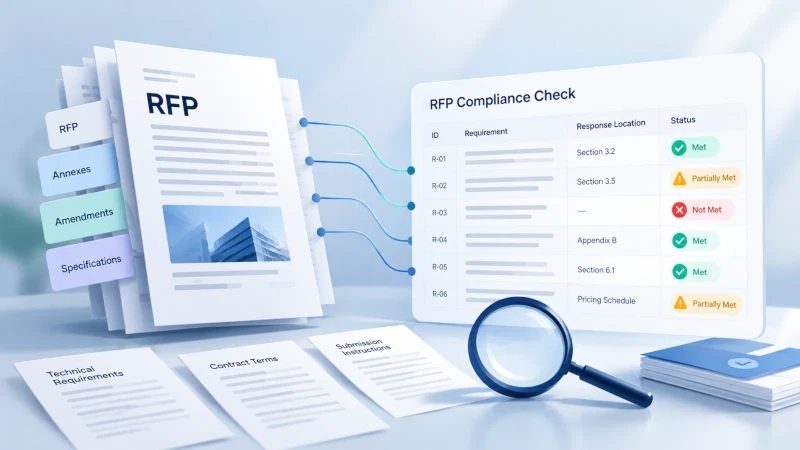
Consider this illustrative compliance matrix for an enterprise document management procurement.
| ID | RFP Requirement | Mandatory | Response Evidence | Status |
|---|---|---|---|---|
| R-01 | Provide role-based access control | Yes | Technical proposal, Section 3.2 | Met |
| R-02 | Support Microsoft Entra ID integration | Yes | Technical proposal, Section 3.5 | Partially Met |
| R-03 | Provide disaster recovery procedures | Yes | No supporting document located | Not Met |
| R-04 | Submit three relevant client references | Yes | Appendix B | Met |
| R-05 | Provide administrator training | No | Implementation plan, Section 6.1 | Met |
| R-06 | Submit a signed pricing schedule | Yes | Pricing appendix, unsigned | Partially Met |
This example demonstrates why locating relevant text does not automatically establish compliance.
A proposal may mention identity management without adequately addressing the specified integration. Similarly, including an unsigned pricing schedule does not satisfy an explicit signature requirement.
The matrix should also distinguish missing evidence from confirmed noncompliance. A bidder may possess a required capability but fail to document it. That situation requires a different corrective action from a genuine inability to meet the requirement.
Step 4: Verify the Supporting Evidence
Every requirement marked as satisfied should have identifiable evidence.
The reviewer must locate the exact paragraph, table, attachment, or supporting document that addresses the requirement and determine whether it provides sufficient detail.
Suppose the RFP requires multifactor authentication for administrative accounts. The proposal states that the solution provides secure authentication.
Although the statement is related, it does not establish that multifactor authentication is supported. The reviewer should request an explicit explanation of the authentication mechanism or another form of evidence demonstrating compliance.
Evidence should be evaluated for relevance, completeness, consistency, and validity.
A certification must satisfy the requested qualification and any applicable validity conditions. A customer reference must meet the stated eligibility criteria. A project schedule must support the proposed delivery commitments.
Cross-document consistency is equally important. A technical proposal may promise implementation within 12 weeks while the project schedule describes a 16-week delivery. Both sections may appear complete individually, but the conflicting commitments require resolution.
The reviewer should also verify that cited attachments are actually included in the submission package. References to missing documents are common when proposals undergo multiple revisions.
Step 5: Prioritize Missing and Partially Met Requirements
After verifying the evidence, the compliance matrix should identify unresolved requirements.
These findings need to be evaluated according to their potential consequences rather than treated as equally significant.
A missing mandatory declaration may create an immediate eligibility concern. An incomplete explanation of an optional feature may primarily affect technical scoring. A conflicting contractual commitment could introduce legal and commercial exposure.
For each unresolved requirement, record the problem, required correction, responsible person, and deadline.
A missing disaster recovery document may require the technical architect to describe backup arrangements, recovery responsibilities, and recovery procedures. An unsigned pricing schedule may require approval from an authorized company representative.
Some findings cannot be resolved through document changes. A bidder may lack a mandatory qualification or be unable to meet a required delivery deadline.
In those circumstances, the proposal manager must determine whether the procurement rules permit clarification, an alternative response, or an explicitly stated exception.
Concealing an actual limitation behind ambiguous wording may introduce contractual risks that are more serious than identifying the issue before submission.
Step 6: Conduct a Realistic Pre-Submission Review
Consider a hypothetical company, CloudDoc Solutions, responding to an RFP for an enterprise document management platform.
The solicitation contains 85 pages, together with technical specifications, contractual conditions, and supporting schedules. CloudDoc prepares a 110-page proposal describing its technical approach, implementation methodology, delivery team, qualifications, and pricing.
For illustration, assume the complete solicitation package contains 120 distinct requirements. The initial compliance review produces the following results:
| Compliance Status | Requirements | Percentage |
|---|---|---|
| Met | 104 | 86.7% |
| Partially Met | 11 | 9.2% |
| Not Met | 5 | 4.2% |
| Total | 120 | 100% |
These figures are illustrative, not actual customer results.
The review identifies several meaningful issues. The technical proposal mentions identity integration but provides insufficient detail about the required directory service. Disaster recovery information is incomplete, and a mandatory declaration is missing from the submission package.
Several other findings involve missing references to existing documentation rather than missing capabilities.
The proposal manager distributes these findings to the appropriate reviewers. The solution architect expands the identity integration section, the operations team supplies the required recovery information, and the commercial team completes the declaration.
After the corrections, the team reviews the updated proposal against the original requirements and confirms that the supporting documents are included in the final package.
The example illustrates an important distinction: initial compliance findings do not automatically indicate deficiencies in the proposed solution. Some represent incomplete explanations, others represent missing documentation, and some may reveal genuine capability gaps.
The review process must distinguish between them before the proposal can be approved.
Step 7: Automate Document Comparison With BidCompliance
Manual compliance reviews are practical for smaller proposals with a limited number of requirements. For large procurement packages, however, maintaining traceability becomes increasingly labor-intensive.
A reviewer may need to move repeatedly between the RFP, technical proposal, contractual attachments, and evidence files. Requirements may be repeated or expressed differently across documents, and subsequent revisions can invalidate earlier assessments.
Automated document analysis can reduce this repetitive work by extracting requirements and searching the response package for corresponding evidence.
BidCompliance provides a pre-submission compliance analysis process designed for this purpose. Proposal teams upload their RFP documents alongside the proposed submission package, allowing the application to extract requirements and compare them against the bid content.
The resulting compliance matrix classifies requirements as Met, Partially Met, or Not Met, with supporting citations that help reviewers locate relevant evidence in the uploaded documents. The analysis supports multi-document bid packages, including annexes and supporting files.
In the CloudDoc example, the team could upload the solicitation and current proposal to obtain an initial compliance report. Rather than manually locating every requirement and searching through the response, reviewers could begin with the extracted matrix and concentrate on investigating gaps, validating evidence, and correcting incomplete answers.
After revising the proposal, the team could run another analysis to evaluate the updated documents.
Automation does not eliminate the need for professional judgment. An automated assessment may identify relevant language without fully establishing compliance, or overlook evidence expressed in an unusual format. Contractual interpretation, technical feasibility, and final approval remain human responsibilities.
The practical benefit is a more systematic starting point for review, allowing experienced team members to concentrate on issues requiring investigation rather than spending most of their time searching documents.
Step 8: Verify the Final Submission Package
Requirement-level compliance is only one part of the submission process. Even a carefully reviewed proposal can encounter problems when the final files differ from the versions previously evaluated.
Before submission, the proposal manager should verify the complete package against the solicitation instructions.
The final check should cover:
- Document completeness: Every required form, declaration, attachment, schedule, and supporting document is included.
- Formatting and structure: File types, naming conventions, page limits, document organization, and required templates follow the RFP instructions.
- Approvals and signatures: Required authorizations have been completed by appropriate representatives.
- Version consistency: Final documents incorporate approved corrections without introducing conflicting statements.
- Submission instructions: The designated portal, deadline, time zone, and any file size restrictions have been verified.
This review should use the actual files intended for submission, preferably after they have been assembled into their final format.
For electronic submissions, sufficient time should be reserved to handle upload problems, authentication failures, or unexpected portal restrictions.
Organizations should retain the approved document versions, final compliance matrix, and submission confirmation as part of their procurement records.
Common RFP Compliance Mistakes to Avoid
One recurring mistake is treating the compliance matrix as an administrative document that is updated only near the submission deadline. When requirements are tracked from the beginning of proposal preparation, they can guide writing assignments, technical decisions, and evidence collection.
Another problem arises when compliance is assessed entirely through self-declaration. Proposal authors understand what they intended to communicate, which can make it difficult to recognize when the written response is incomplete. Independent reviewers provide a different perspective by evaluating the evidence actually present in the documents.
Teams can also place too much confidence in an overall compliance percentage. A proposal that meets 98% of its requirements may still fail a mandatory eligibility condition. Aggregate compliance scores should support management reporting rather than substitute for requirement-level risk assessment.
Finally, document changes can undermine previously verified compliance. Revising an architecture section, replacing an attachment, or adjusting delivery commitments may affect several requirements simultaneously. Significant revisions should trigger reassessment, and the final submission package should always be checked against the approved version.
Building a More Reliable RFP Compliance Process
Organizations that respond to RFPs regularly benefit from treating compliance verification as part of proposal development rather than a final administrative exercise.
The process begins with a complete requirements register, continues through evidence-based review, and ends with verification of the actual submission package. Clear ownership, traceable findings, and appropriate review checkpoints make it easier to identify issues while corrections remain practical.
Manual methods can support this process, particularly for smaller procurements. Automated analysis becomes useful as document volumes, requirement counts, and review complexity increase, provided its findings remain subject to human validation.
A practical first step is to select a recent RFP and compare its requirements with the proposal that was submitted. Build a compliance matrix, identify where supporting evidence appears, and examine any requirements that cannot be verified confidently.
That exercise provides a concrete picture of the organization's current review practices and the improvements that would most directly reduce submission risk.
A reliable RFP compliance process gives proposal teams something more valuable than a final checklist: a defensible understanding of how their submission satisfies the buyer's requirements before the deadline arrives.
Ready to review your next bid with more confidence?
Upload your RFP and bid documents to identify compliance gaps with cited evidence.
Start a compliance check