Proposal review
Create and Use an RFP Compliance Matrix
Learn how to build an RFP compliance matrix, track mandatory requirements, map proposal responses to supporting evidence, and identify compliance gaps before submission.
How to Create and Use an RFP Compliance Matrix
A proposal manager receives a request from the technical team asking whether the proposed solution must support customer-managed encryption keys. The requirement appears somewhere in the procurement package, but nobody can immediately locate it. Meanwhile, the commercial team is waiting for confirmation of the implementation schedule, and the security specialist has discovered that several mandatory questions in an appendix have never been assigned.
The proposal itself is progressing. Sections are being written, documents are being reviewed, and contributors are reporting that their work is nearly complete. Yet nobody can confidently answer a fairly basic question: How much of the RFP has actually been addressed, and what evidence supports that assessment?
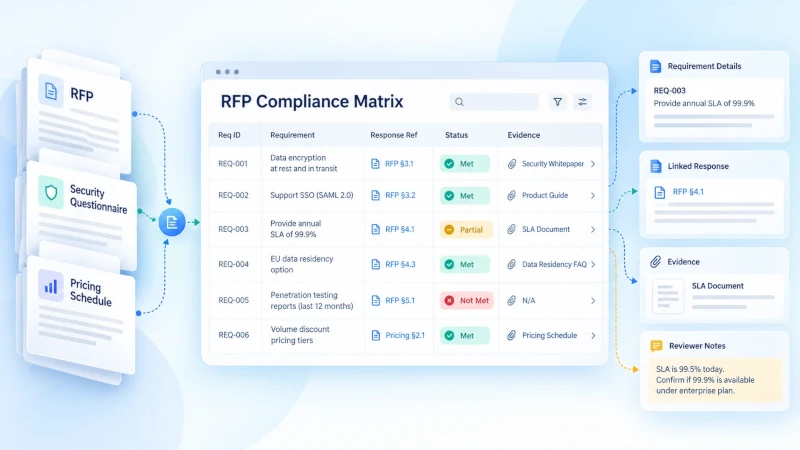
An RFP compliance matrix provides a practical answer. It organizes the buyer's requirements into a structured register, connects them to the relevant parts of the proposal, and records whether each obligation has been satisfied. More importantly, it makes incomplete responses and unresolved questions visible while there is still time to address them.
Creating such a matrix is relatively straightforward. Maintaining one accurately through several rounds of proposal revisions requires more discipline, particularly when hundreds of requirements are distributed across multiple documents.
What an RFP Compliance Matrix Actually Does
An RFP compliance matrix is a structured record connecting individual procurement requirements with the bidder's responses and supporting evidence. Each entry identifies what the buyer requested, where the corresponding answer can be found, and whether that answer adequately addresses the requirement.
The matrix serves different purposes during proposal preparation. Initially, it functions as a planning instrument, helping the proposal manager distribute work and confirm that every obligation has an owner. As sections are completed, it becomes a progress tracker. During the final review, the emphasis shifts toward verification: reviewers examine the actual response and determine whether the available evidence supports the compliance assessment.
These activities are related, but they should not be confused. A contributor may finish writing an assigned section without having satisfied every requirement associated with it. A document may exist without containing sufficient evidence. Similarly, a capability may be supported by the proposed solution but inadequately explained in the submission.
The matrix preserves these distinctions, provided the team records findings carefully rather than treating completion as a simple checkbox.
For procurement teams evaluating submissions, a requirements matrix can also help establish a consistent framework for examining proposals against the published solicitation. However, evaluation must still follow the procurement's stated criteria and applicable rules.
Extracting Requirements Without Losing Their Meaning
The quality of the matrix depends heavily on the initial requirements extraction. Missing an obligation at this stage means it may never receive an assigned response or appear in subsequent compliance reviews.
Start with the complete procurement package, including the main RFP, statements of work, technical specifications, contractual schedules, pricing templates, amendments, and official clarifications. The source documents should be version-controlled, particularly when amendments modify requirements that contributors have already begun addressing.
A common extraction mistake involves treating an entire paragraph as one requirement.
Consider the following statement:
"The proposed solution shall support encrypted storage, role-based access control, comprehensive audit logging, and configurable document retention policies."
Although presented as a single sentence, it contains four distinct technical obligations. A response might explain encryption and access control thoroughly while overlooking audit logging and retention configuration. Assessing the complete sentence as one requirement makes that omission harder to recognize.
Separating the obligations creates four independently verifiable entries, each linked to the original source paragraph. The original wording should remain accessible so that reviewers can examine the full context when necessary.
Requirements also need classification. Mandatory eligibility conditions, technical capabilities, evidence requirements, contractual commitments, and submission instructions carry different implications. The word "shall" may indicate an obligation, but it does not automatically establish whether failure to satisfy that obligation will disqualify the proposal. Such consequences depend on the solicitation and applicable procurement rules.
A good requirements register preserves both the individual obligation and the context needed to interpret it correctly.
Building a Practical Compliance Matrix
For many teams, a spreadsheet is the easiest place to begin. Excel or LibreOffice Calc can accommodate several hundred requirements, allow filtering by status or responsibility, and provide a shared reference during preparation meetings.
The structure should capture enough information to support review without becoming so complicated that contributors stop maintaining it.
Consider a fictional company preparing a proposal for an enterprise document management platform. The RFP includes security controls, identity integration, disaster recovery, implementation services, and commercial documentation.
An initial matrix might look like this:
| ID | Requirement | Response Reference | Compliance Status | Supporting Evidence |
|---|---|---|---|---|
| R-001 | Role-based access control | Technical Proposal, Section 3.2 | Met | Access control design |
| R-002 | Microsoft Entra ID integration | Technical Proposal, Section 3.5 | Partially Met | General identity integration description |
| R-003 | Documented disaster recovery procedures | No response located | Not Met | No supporting document found |
| R-004 | Three relevant client references | Appendix B | Met | Completed reference forms |
| R-005 | Administrator training | Implementation Plan, Section 6.1 | Met | Training schedule and curriculum |
| R-006 | Signed pricing schedule | Commercial Appendix | Partially Met | Completed schedule, signature missing |
This example illustrates the difference between locating a response and establishing compliance.
The identity integration requirement has a corresponding section, but the description may not demonstrate support for the specific platform requested. The disaster recovery requirement has no identifiable evidence. The pricing schedule exists, yet an explicit administrative obligation remains unfinished.
For an actual submission, additional fields would normally identify the source document, page number, requirement owner, mandatory status, review date, and outstanding corrective action. These details become especially useful when different people prepare and review the same material.
Ownership and the Problem of Shared Responsibilities
A requirement involving several departments still needs one accountable owner.
Disaster recovery provides a useful example. The infrastructure team may understand backup and restoration procedures, the software architect may be responsible for application recovery behavior, and the commercial team may need to confirm contractual recovery commitments. Each contributor can provide accurate information while the combined response remains incomplete.
Assigning accountability to the solution architect or another designated owner creates a clear responsibility for coordinating the final answer. Other specialists contribute the necessary material, but the owner ensures that the response addresses the complete obligation.
Ownership should extend through review and correction. When a reviewer identifies missing evidence, the finding needs to return to someone who can resolve it, not disappear into a general comment asking the team to revisit the proposal.
How to Assess Compliance Without Confusing It With Progress
A matrix often becomes unreliable when the team uses one status field for both drafting progress and compliance.
The distinction is straightforward: a completed answer is not necessarily a compliant answer.
A proposal author may have finished the technical section describing authentication, while the reviewer remains unable to verify the required integration. The drafting task is complete, but compliance has not been established.
Maintaining separate fields prevents this misunderstanding. Preparation status might indicate that a response is In Progress, Ready for Review, or Approved. Compliance status should reflect the actual evidence, using categories such as Met, Partially Met, and Not Met.
Even these classifications require careful interpretation. A Not Met finding may indicate that the proposed capability genuinely does not exist, or simply that the reviewer could not locate sufficient documentation. Those situations have very different consequences.
The matrix should record the reason for the assessment, particularly when the finding is disputed or depends on technical interpretation.
Following a Requirement Through Review and Correction
Return to the fictional document management procurement. The initial review identifies Microsoft Entra ID integration as Partially Met because the proposal discusses external identity providers without explaining how the required integration would operate.
The proposal manager assigns the finding to the solution architect, who examines the proposed authentication architecture and confirms whether the requested integration is supported. If the capability exists, the technical section can be expanded with the necessary details. If it does not, the team must evaluate the implications for the proposed solution rather than compensate with ambiguous wording.
Once the response has been revised, the reviewer returns to the original RFP requirement and checks the updated evidence. The finding should remain open until that verification is complete.
The disaster recovery requirement follows a different path. Suppose the operations team already maintains recovery procedures, but those documents were never included in the bid package. The owner must confirm that they satisfy the procurement's stated conditions, including any recovery objectives or documentation requirements, before incorporating the appropriate evidence.
This is why a matrix should track corrective actions alongside compliance status. A finding becomes useful when it identifies what needs to change, who is responsible, and how the team will determine that the problem has been resolved.
During later revisions, previously approved entries may need to be reopened. A change to the implementation schedule, for instance, could affect delivery commitments in several sections and potentially alter the commercial assumptions supporting the bid.
Where Spreadsheet-Based Matrices Begin to Struggle
A spreadsheet can remain entirely adequate for a relatively small RFP with clearly organized requirements and a stable response. Experienced proposal managers can maintain useful registers without specialized software, particularly when contributors work from controlled document versions.
The limitations become more apparent when the procurement package contains hundreds of requirements distributed across several files. Extracting those requirements, locating matching responses, recording evidence, and checking revised documents involve substantial manual cross-referencing.
A spreadsheet can store a reference to Section 4.2, but it cannot determine whether that section genuinely satisfies the requirement. Someone must examine the wording, verify the supporting documents, and evaluate whether the response is sufficiently specific.
Document revisions make the work harder. Sections move, attachments are replaced, and technical commitments change during negotiations between proposal contributors. A compliance reference that was correct earlier may become outdated without anyone noticing.
There is also a tendency for the matrix to develop into a separate administrative artifact. Contributors update their proposal sections but forget to revise the corresponding entries, leaving the register increasingly disconnected from the actual submission.
When that happens, a supposedly comprehensive tracking system may provide less reliable information than the team expects.
Generating an Evidence-Backed Matrix With BidCompliance
Automated document analysis can reduce the repetitive work involved in constructing and verifying a compliance matrix, particularly when requirements and responses are spread across multiple documents.
BidCompliance provides pre-submission RFP compliance analysis. Teams upload procurement documents together with the proposed bid package, allowing the application to extract requirements and compare them with the response content.
The resulting assessment organizes requirements into a compliance matrix and classifies them as Met, Partially Met, or Not Met, with citations pointing to relevant supporting passages. Reviewers can examine those references rather than relying solely on a summary assessment.
For the fictional document management proposal, automated analysis could identify the incomplete identity integration response and the absence of disaster recovery evidence. It could also help reviewers locate material that uses different terminology from the original requirement.
The value becomes apparent when the team must repeat the analysis after revisions. Instead of manually rebuilding every cross-reference, reviewers can analyze the updated package and concentrate on findings that warrant closer examination.
There are limits to what automation can establish. A system may find apparently relevant text without correctly interpreting its technical meaning, or overlook valid evidence expressed in an unusual form. An automated Not Met classification does not necessarily prove that the bidder lacks the capability.
Technical specialists, legal reviewers, and proposal managers remain responsible for validating findings and deciding whether the proposed response satisfies the procurement's conditions.
The distinction between automation and workflow management also matters. Extracting requirements and evaluating documentary evidence are different activities from assigning authors, approving commitments, and coordinating corrections. Teams may continue using their existing project management tools while relying on automated analysis to support compliance verification.
Using the Matrix to Make the Final Submission Decision
The final review should examine the exact documents intended for submission, not an earlier working version.
At this point, the proposal manager needs to confirm that corrective actions have been completed, supporting attachments are present, and amendments have been incorporated. Mandatory requirements deserve particular attention because an apparently small number of unresolved items may have consequences disproportionate to their share of the total.
A proposal meeting 195 of 200 requirements may look nearly complete in a summary report. Yet a missing mandatory qualification or contractual declaration could create a significant problem under the applicable procurement rules. The overall percentage provides a useful measure of review progress, but it cannot establish submission readiness by itself.
The matrix should therefore remain available during final approval, with unresolved findings clearly identified and their consequences understood. Formatting instructions, signatures, file naming conventions, and electronic submission requirements also need verification, since these obligations may not be fully represented in the technical compliance assessment.
After submission, retaining the matrix alongside the approved documents provides a useful record of how the proposal was reviewed.
Making the Matrix Useful Beyond a Single Bid
An RFP compliance matrix becomes more valuable when an organization learns from the information it contains. Repeated omissions may reveal weaknesses in how supporting documents are collected, requirements are assigned, or proposal sections are coordinated.
For example, several bids may reveal that security certifications are requested late, creating unnecessary pressure before submission. The organization could respond by maintaining an approved library of frequently requested documents and introducing an earlier evidence collection checkpoint. Recurring uncertainty about technical ownership may point toward a need for clearer responsibilities between solution architecture, operations, and delivery management.
These are process improvements, and they do not necessarily require new technology.
Teams handling larger or more frequent submissions may eventually benefit from automated requirement extraction and document comparison, particularly when manual review consumes substantial specialist time. Others may continue using a spreadsheet successfully, provided it remains accurate and the review process is consistently followed.
The real value of an RFP compliance matrix lies in maintaining a reliable connection between the buyer's requirements, the bidder's responses, and the evidence supporting each compliance decision. Start with a structure that your team can maintain, review the evidence rather than accepting completion claims, and keep the matrix aligned with the documents that will actually be submitted.
Ready to review your next bid with more confidence?
Upload your RFP and bid documents to identify compliance gaps with cited evidence.
Start a compliance check