Proposal review
Tender Compliance Tracking: A Practical Guide
Learn how to track tender requirements, assign ownership, monitor compliance status, and manage supporting evidence throughout proposal preparation. Compare spreadsheet tracking with automated compliance analysis.
Tender Compliance Tracking: A Practical Guide
A tender response involving several hundred requirements can quickly become difficult to manage, even when the proposal team is experienced and well organized. Technical specialists work on different sections, commercial teams prepare pricing, legal representatives review contractual obligations, and supporting documentation arrives from several departments. Meanwhile, the buyer may issue amendments or clarifications that change requirements already assigned to individual contributors.
The challenge becomes particularly visible during proposal review. A requirement marked as complete may still be awaiting supporting evidence, another may have been answered in the wrong section, and an amendment might have introduced an obligation that nobody has been assigned to address. The proposal manager needs to understand the status of the entire submission, but that information is often distributed across spreadsheets, documents, emails, and conversations with individual contributors.
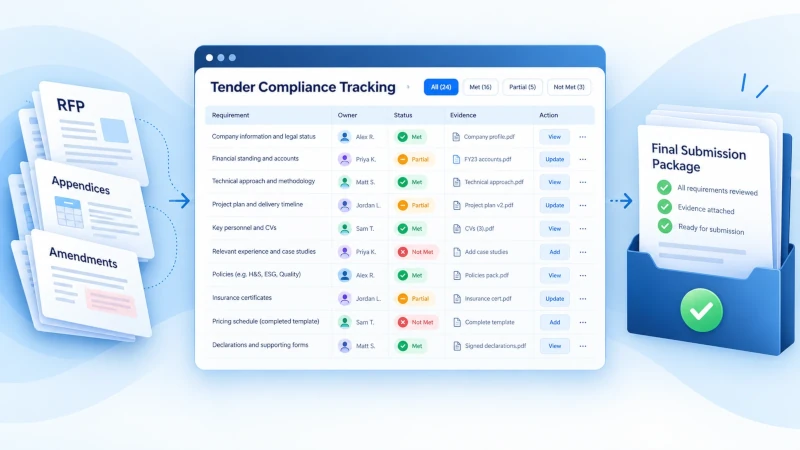
Tender compliance tracking provides a structured way to manage requirements throughout proposal preparation, from initial extraction and assignment through evidence verification and final submission. It establishes a connection between what the buyer requires, who is responsible for addressing it, what the proposal contains, and which issues remain unresolved.
The objective is to maintain an accurate picture of the proposal's compliance position while there is still time to correct problems.
Why Tender Compliance Becomes Difficult to Manage
Tender documents rarely follow a structure that makes every requirement easy to identify. A procurement package may contain a main RFP, technical specifications, commercial schedules, evaluation criteria, contractual conditions, and several appendices. Requirements can appear in ordinary paragraphs, detailed tables, footnotes, or instructions concerning the format of the final submission.
Some obligations are straightforward. The bidder may be required to provide three customer references or submit a signed declaration. Others require interpretation across multiple sections, particularly when technical capabilities, service responsibilities, and contractual commitments overlap.
Consider a requirement stating that the proposed system must provide audit logging, retain security events for a specified period, and allow authorized administrators to retrieve those records. Although expressed in one sentence, it contains several distinct obligations. A response describing audit logging without addressing retention or retrieval would leave the requirement only partially satisfied.
The difficulty increases when multiple contributors work on the proposal. A security specialist may describe logging capabilities, an infrastructure architect may document storage arrangements, and a project manager may be responsible for operational procedures. Without clear requirement ownership, everyone can complete their assigned material while part of the original obligation remains unanswered.
Tracking therefore needs to extend beyond recording that someone has started or completed a section. Each requirement must remain traceable to a responsible person, a specific response, and the evidence needed to establish compliance.
Establish a Complete Requirements Register
The first step is to establish a single register containing the requirements applicable to the tender.
Start with the complete procurement package, including amendments and official clarifications. Each requirement should retain its source document, section reference, and identifier so that reviewers can return to the original wording whenever questions arise. Where several obligations appear together, they should be separated when they can be independently evaluated.
A useful register captures both the requirement itself and the information needed to manage its completion.
| Field | Purpose |
|---|---|
| Requirement ID | Provides a unique reference throughout preparation |
| Source reference | Identifies the original document and section |
| Requirement description | Records the specific obligation to be addressed |
| Requirement category | Distinguishes technical, commercial, legal, and administrative obligations |
| Mandatory status | Identifies requirements with potential eligibility implications |
| Owner | Identifies who is accountable for the response |
| Response reference | Locates the relevant proposal section or attachment |
| Compliance status | Records the current assessment of the response |
| Outstanding action | Documents corrections, missing evidence, or unresolved questions |
The register should be created early enough to guide proposal preparation. Building it shortly before submission may still uncover omissions, but it loses much of its value as a coordination tool.
Someone also needs responsibility for maintaining the register itself. Usually this will be the proposal manager or a designated compliance coordinator, particularly when several contributors are editing different sections.
Assign Requirement Ownership Clearly
Ownership is one of the most easily underestimated aspects of tender compliance tracking.
A requirement may involve several departments, but responsibility for ensuring that it receives a complete response should be unambiguous. For example, a disaster recovery requirement might depend on information from infrastructure operations, software architecture, security, and commercial management. These specialists can contribute evidence, but a designated owner must coordinate the complete response.
Without that distinction, the proposal team can develop gaps that remain invisible until the final review. Each contributor assumes another department will address the missing element, while the proposal manager sees several completed sections and reasonably believes the requirement has been covered.
For complex requirements, separating the accountable owner from supporting contributors is useful. The owner ensures that the response addresses the complete obligation, while contributors supply the necessary technical information, documents, or approvals.
Ownership should also include deadlines. A requirement awaiting a certification from a third party presents a different scheduling risk from one that simply needs an additional paragraph. Both may currently appear incomplete, but their likely resolution times are very different.
The tracking system needs to make these dependencies visible before they threaten the submission schedule.
Track Compliance Status Separately From Work Progress
One of the most common weaknesses in tender tracking is using a single status field to represent several different things.
A proposal author may mark a requirement as complete because the response has been written. The compliance reviewer, however, may discover that the answer lacks supporting evidence or addresses only part of the original obligation.
Both assessments can be correct within their respective contexts. The drafting work is complete, but compliance has not been established.
Work progress and compliance status should therefore be tracked separately.
Work progress describes the state of preparation, such as Not Started, In Progress, Ready for Review, or Approved. Compliance status describes how well the actual proposal satisfies the requirement, commonly using Met, Partially Met, and Not Met.
This distinction becomes especially valuable when managers need to prioritize outstanding work. A requirement marked Ready for Review may require only validation, while another marked Partially Met may need significant technical clarification or changes to the proposed solution.
A proposal should not be treated as compliant simply because every contributor has finished writing their assigned sections.
Evidence Tracking and Document Traceability
Compliance assessments need supporting evidence. Without it, reviewers are left relying on general statements, individual assurances, or their own familiarity with the proposed solution.
For every requirement assessed as satisfied, the register should identify where the supporting information can be found. That might be a paragraph in the technical proposal, a table in the implementation schedule, a certificate, a completed questionnaire, or a separate supporting attachment.
The evidence must also address the specific wording of the requirement.
An RFP asking for multifactor authentication cannot necessarily be satisfied by a statement describing secure login. Similarly, a requirement for documented recovery procedures involves more than a general assurance that the proposed system is highly available.
Document validity creates another consideration. Certifications may have expiration dates, customer references may need to meet particular qualification criteria, and contractual declarations may require authorized signatures.
Reviewers should verify these details rather than merely confirm that an attachment exists.
Evidence references also need to remain accurate as the proposal changes. A requirement pointing to Section 4.2 may become difficult to verify after the document is reorganized, especially when several authors work on different versions. Stable identifiers, controlled document versions, and periodic verification help preserve traceability.
A Practical Example of Tracking a Complex Tender
Consider a hypothetical technology company responding to an enterprise software procurement. The tender contains 240 requirements covering application functionality, security, integration, implementation, support, commercial conditions, and submission instructions.
The proposal manager assigns requirements to six contributors and maintains a central register. Technical requirements are divided between the solution architect and development lead, security obligations go to the security specialist, and commercial and contractual requirements are assigned to the appropriate representatives.
After the first draft, the team completes an initial compliance review.
| Compliance Status | Requirements | Next Action |
|---|---|---|
| Met | 186 | Confirm evidence remains valid |
| Partially Met | 38 | Review incomplete responses |
| Not Met | 16 | Investigate missing responses or capabilities |
| Total | 240 | Continue corrective review |
These figures are illustrative rather than actual customer results.
Among the partially met requirements, several involve incomplete integration descriptions. The proposal states that the system supports external identity providers but does not explain how the buyer's specified identity platform will be integrated. Other findings concern implementation responsibilities that differ between the technical response and the proposed project schedule.
The missing requirements present a different set of problems. Some involve documents that exist but have not been included in the submission package. Others concern capabilities that the company must verify before making contractual commitments.
Rather than distributing a general request for everyone to review their sections again, the proposal manager assigns specific findings to individual owners. The integration specialist receives the identity-related questions, the project manager resolves delivery inconsistencies, and the commercial team collects the outstanding declarations.
The register now serves as a coordination mechanism. During subsequent review meetings, the team concentrates on unresolved findings and verifies completed corrections against the original requirements.
If a later amendment changes the required implementation schedule, the affected requirements can be identified and reopened for review without assuming that previously approved answers remain valid.
Spreadsheet Tracking Versus Automated Compliance Analysis
Spreadsheets remain a practical choice for many tender teams. They are familiar, inexpensive, and flexible enough to manage requirement ownership, preparation status, evidence references, and outstanding actions.
For smaller procurements with clearly organized requirements, a spreadsheet may be entirely adequate. The proposal manager can filter outstanding items, assign responsibility, and maintain a useful record without introducing another application.
The limitations become more apparent as document volume and revision frequency increase. Requirements must be extracted manually, references are often entered by hand, and reviewers spend considerable time locating the relevant response in the proposal. A spreadsheet can show that a requirement has been marked Met, but it cannot independently establish whether the cited paragraph actually satisfies the obligation.
Automated compliance analysis addresses part of this difficulty by comparing tender requirements against the proposal documents themselves.
| Activity | Spreadsheet Tracking | Automated Compliance Analysis |
|---|---|---|
| Requirement extraction | Manual identification and entry | Automated extraction from documents |
| Requirement ownership | Manually assigned and maintained | Usually managed through the team's workflow |
| Compliance verification | Reviewer compares documents | System identifies possible matches and gaps |
| Evidence references | Entered and updated manually | Can be generated from analyzed documents |
| Outstanding actions | Flexible manual tracking | Findings inform corrective work |
| Document revisions | References require manual checking | Reanalysis can assess revised documents |
The distinction is useful because tracking workflow and verifying document compliance are related but different responsibilities. A spreadsheet may remain the best place for coordinating contributors, while automated analysis can reduce the effort involved in identifying missing responses and examining supporting evidence.
Using BidCompliance for Requirement Verification
BidCompliance provides automated pre-submission analysis for organizations that need to compare tender requirements with their proposed responses.
The application allows teams to upload their RFP documents and bid package, including supported annexes and supporting files. It extracts requirements from the procurement documents and compares them against the submitted proposal content.
The resulting compliance matrix classifies requirements as Met, Partially Met, or Not Met, with supporting citations that allow reviewers to locate the relevant source material.
For the hypothetical 240-requirement tender, this analysis could help the team identify incomplete responses and missing evidence without manually searching through every document. Reviewers could then investigate the highlighted findings, confirm whether the assessment is correct, and assign the necessary corrections through their established workflow.
After revisions, a further analysis can be performed against the updated proposal package.
BidCompliance is particularly useful for the document verification component of compliance tracking. Requirement ownership, contributor deadlines, internal approvals, and corrective-action management still need to be coordinated by the proposal team.
This division of responsibilities is practical. Automated analysis can handle repetitive document comparison, while experienced professionals remain responsible for interpreting requirements, evaluating evidence, and making technical or contractual decisions.
Managing Outstanding Actions Before Submission
A compliance register becomes most valuable when it helps the team resolve findings rather than merely record them.
Outstanding actions should describe the specific correction required. A note stating "Review security section" provides little direction, particularly under deadline pressure. A more useful instruction would identify the requirement, explain what evidence is missing, and specify who must supply it.
Not every finding requires the same response. Some can be resolved by adding an existing document or clarifying a paragraph. Others may require technical investigation, additional commercial approval, or changes to the proposed solution.
The proposal manager should prioritize actions according to mandatory status, potential evaluation consequences, resolution effort, and dependencies. A missing certification requiring external confirmation may need attention earlier than an incomplete explanation that the technical author can correct immediately.
Once the responsible contributor reports completion, the reviewer should verify the revised material. Closing an action without examining the actual correction allows the same gap to remain in the final submission.
Changes made to satisfy one requirement may also affect others. A revised delivery commitment, for example, could require corresponding updates to pricing, resource allocation, and implementation schedules.
Final Verification and Maintaining the Process
The last compliance review should examine the actual submission package rather than the working documents used during preparation.
Every mandatory requirement needs an acceptable resolution, supporting attachments must be present, and previously identified inconsistencies should have been addressed. The team must also confirm that final signatures, document formats, pricing schedules, and submission instructions meet the buyer's requirements.
A compliance percentage alone cannot establish readiness. A proposal satisfying 98% of its requirements may still contain an unresolved condition that affects eligibility, depending on the applicable procurement rules.
After submission, the completed register provides useful material for improving future tenders. Repeated gaps in supporting evidence may indicate that documentation is collected too late. Frequent uncertainty about ownership may reveal unclear responsibilities, while recurring inconsistencies could point to weaknesses in document coordination.
Organizations can use these observations to refine templates, clarify responsibilities, and introduce compliance reviews earlier in preparation.
Effective tender compliance tracking makes the state of a proposal visible throughout its development. By connecting requirements with ownership, evidence, review findings, and corrective actions, bid teams can address problems systematically instead of discovering them during the final hours before submission.
The underlying process can begin with a carefully managed spreadsheet and evolve to incorporate automated compliance analysis as complexity increases. What matters is maintaining a reliable connection between the buyer's requirements and the proposal that will ultimately be submitted.
Ready to review your next bid with more confidence?
Upload your RFP and bid documents to identify compliance gaps with cited evidence.
Start a compliance check